Direct observations of strong jets transporting deep and bottom water into the Indian Ocean through the fracture zones of the Southwest Indian Ridge. (Journal of Geophysical Research: Oceans, 2026)
Abstract
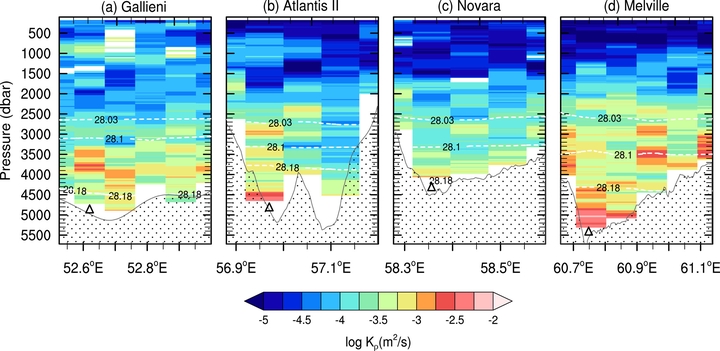
The Indian Ocean plays a crucial role in the abyssal overturning circulation, transforming Antarctic Bottom Water (AABW) into lighter water. In the western Indian Ocean, the only path for AABW to reach the subtropics as part of the global overturning is through the fracture zones of the Southwest Indian Ridge. This mid-ocean ridge has seven known fracture zones in this area, but until recently, only Atlantis II has been investigated, given the historical shortage of in situ observations in the region. To address this gap, we collected as part of the Deep Madagascar Basin (DMB) Experiment (DMB) the first comprehensive surface-to-bottom measurements of velocities, water properties, and tracers at four fracture zones deemed to transport AABW northward - Gallieni, Atlantis II, Novara, and Melville. Based on these new observations, we estimate the relative contributions of each fracture zone to the overall northward transport in the abyss and assess the strength of diapycnal turbulent mixing. Our observations reveal two strong northward deep jets transporting AABW, one at the Novara (46.0 cm/s at 4,370 dbar) and another at the Melville (23.8 cm/s at 4,360 dbar) fracture zones, and provide evidence of the persistence of the previously observed Atlantis II jet. Contrary to earlier assumptions, we find that the Melville fracture zone, rather than the Atlantis II, is the primary contributor to the northward transport of deep and bottom water, at least during the DMB period.
Lois Baker
Flora Philip Fellow and EPSRC National Fellow in Fluid Dynamics
I’m a postdoctoral researcher interested in using mathematics to understand oceanic fluid dynamics.