Research
I use mathematical models and numerical simulations to understand the small-scale physics of the ocean — the waves and turbulence that are too small for climate models to resolve, but which help set the global ocean circulation.
Small-scale mixing in the Arctic Ocean
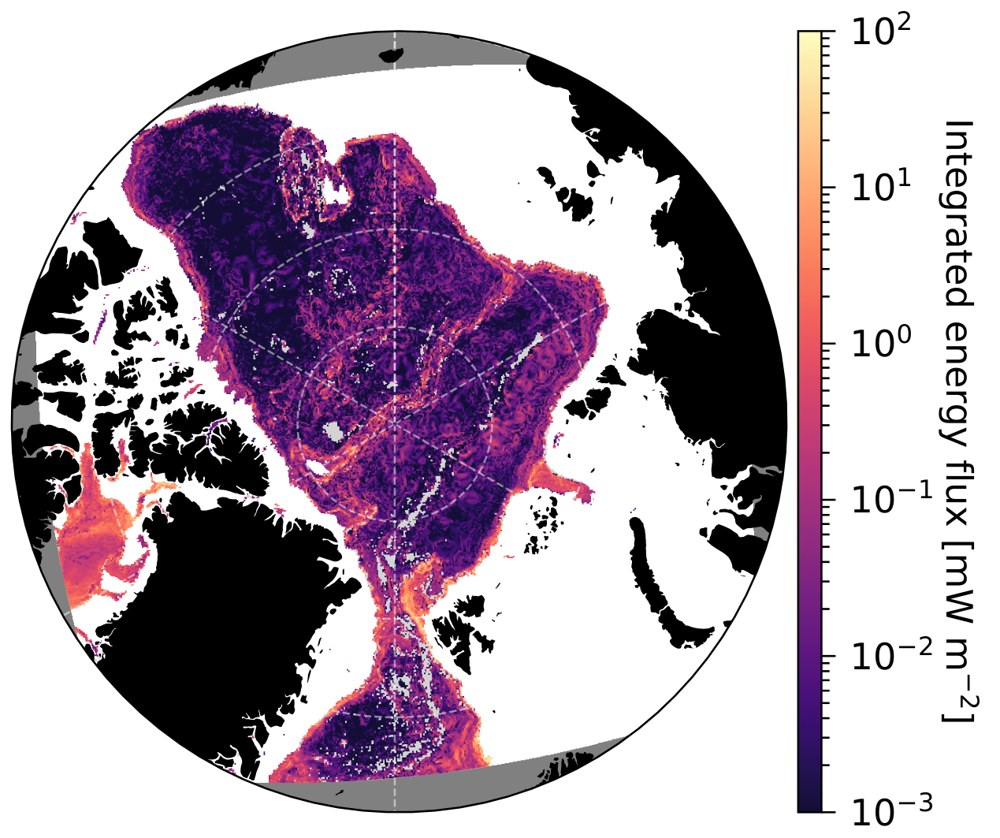
As the climate warms, Arctic currents are expected to become more energetic, generating more turbulence from small-scale processes such as internal waves — and potentially more heat flux from the relatively warm deep Arctic to the sea ice above. These processes are dynamically different from those elsewhere in the ocean and are not represented in climate models.
My new UKRI Future Leaders Fellowship project, entitled An Ocean in Flux: Turbulence in a Changing Arctic, will develop theory for these processes and verify it against idealised simulations, with the goal of developing parameterisations for ocean and climate models. This builds on work by PhD student Tianshu Liu that characterises topographically-generated internal waves in the Arctic (preprint 2026).
Lagrangian methods for wave–mean flow decomposition
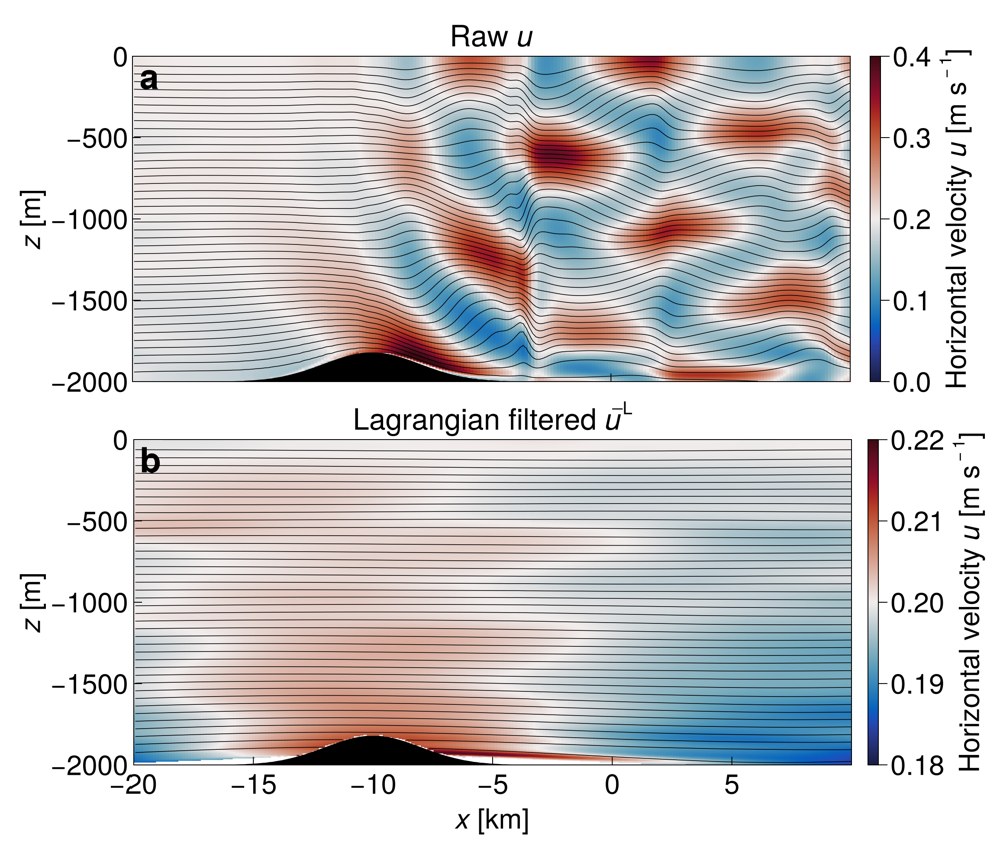
Geophysical flows are typically composed of wave and mean motions with a wide range of overlapping temporal scales, making separation between the two types of motion in wave-resolving numerical simulations challenging. Lagrangian filtering — whereby a temporal filter is applied in the frame of the flow — is an effective way to overcome this challenge, allowing clean separation of waves from mean flow based on their frequency in a Lagrangian frame.
Building on work by Kafiabad and Vanneste (JFM 2023) on computing Lagrangian means, we’ve developed PDE-based methods for Lagrangian filtering that run alongside a simulation, without tracking particles (JFM 2025), made them more efficient using exponential filters (Phys. Rev. Fluids 2025), and extended them to volume-preserving averages (arXiv 2026). I’m building these tools into OceananigansLagrangianFilter.jl for the Oceananigans ocean model.
Flow–topography interaction
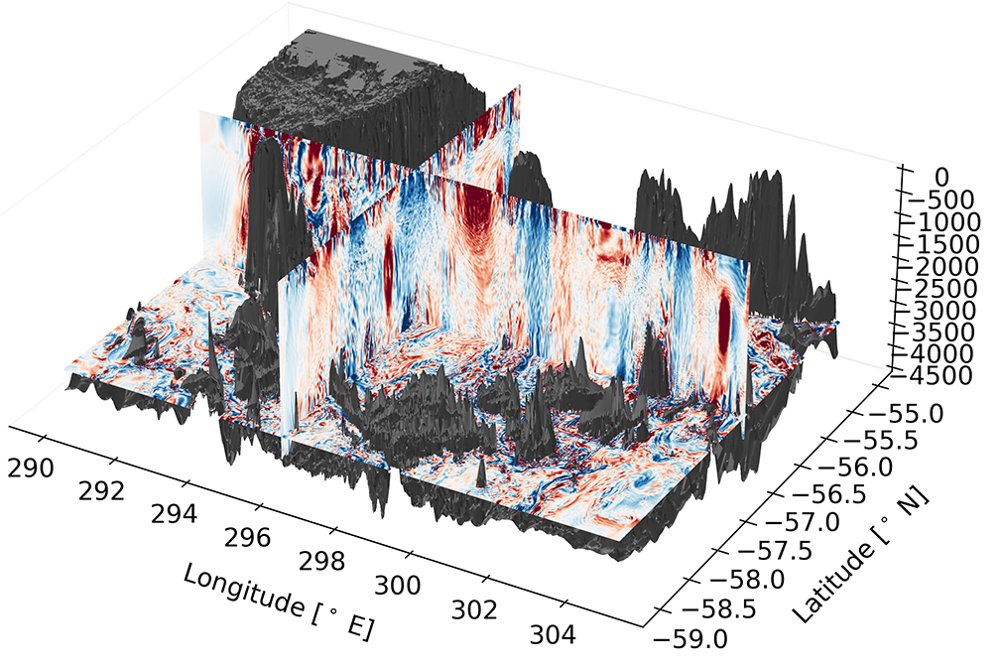
When ocean currents flow over the rough seafloor they generate lee waves, internal tides, wakes, and turbulence, which mix dense bottom waters with lighter waters above. This mixing helps the deepest waters to upwell, closing the lower limb of the global overturning circulation.
During my PhD at Imperial College London, supervised by Prof Ali Mashayek, I studied how lee waves are generated over realistic topography (JGR Oceans 2022), how they can reflect from the ocean surface (JFM 2021), and how topographic turbulence upwells Antarctic Bottom Water in the Drake Passage (AGU Advances 2023). With collaborators I’ve also looked at the role of seamounts in deep-ocean upwelling (PNAS 2024), and at observations of deep jets through the Southwest Indian Ridge (JGR Oceans 2026).
Internal tides and superharmonics
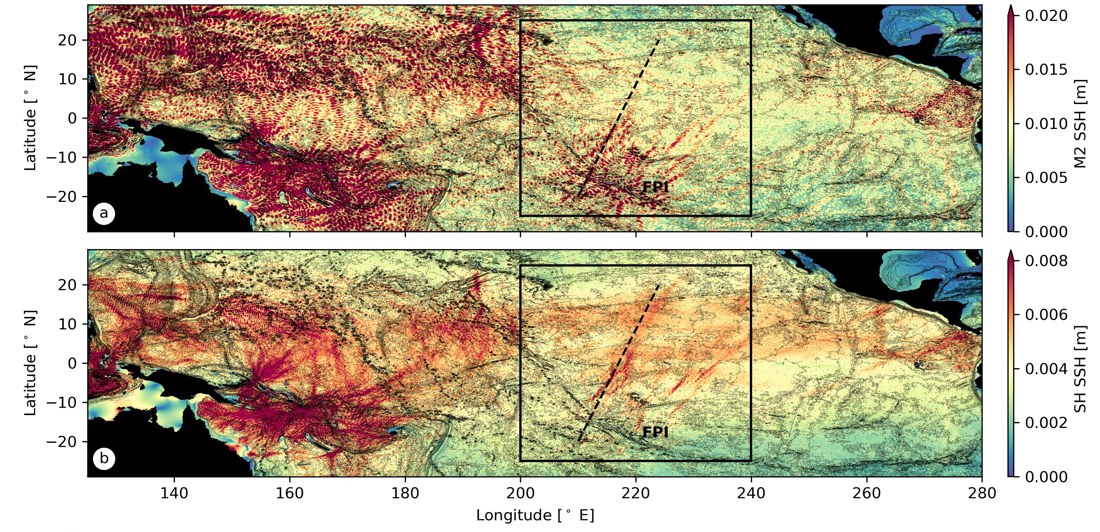
Internal tides are generated when tidal currents flow over seafloor topography, and can carry energy thousands of kilometres before it is dissipated. One way this energy can reach small scales is through the generation of superharmonics — shorter, higher-frequency waves excited by the tide interacting with itself in non-uniform stratification.
As a WHOI GFD Summer Fellow, I worked with Prof Bruce Sutherland to develop a theory for the evolution of internal tide superharmonics (JFM 2020). Later, with Dr Alex Doak and Dr Dianfang Bi at the EPSRC National Fellowships in Fluid Dynamics (NFFDy) Summer Programme, we compared this theory with a global ocean model, finding evidence for this energy pathway in the equatorial Pacific (GRL 2025).